

ALIAS: Evaluating Performance and Memorization in LLM-Written TLA+ Specifications
- Status:
Preprint
- Date:
October 2026
- Authors:
Arslan Bisharat, Mujtaba Nazari, Khushboo Bhadauria, Brian Ortiz, Eric Spencer, Beatriz Santos, TaiNing Wang, George K. Thiruvathukal, Konstantin Läufer, Mohammed Abuhamad
- Institution:
Loyola University Chicago
- Paper:
- DOI:
- Artifact:
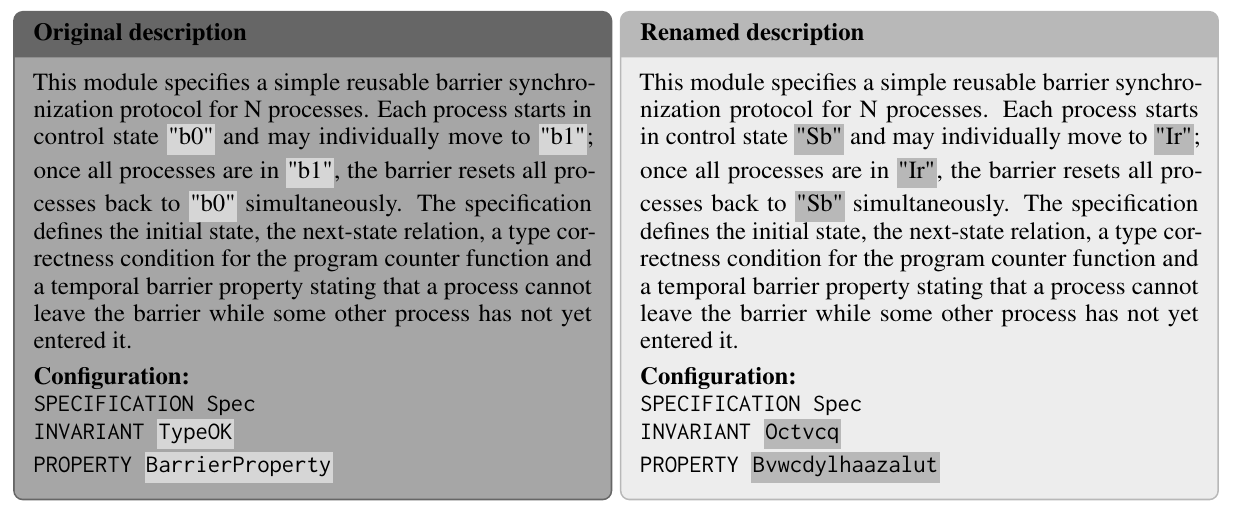
Figure 1. The Barrier task as the model receives it, with the configuration that checks the output. Renamed parts are shaded, and the description states neither required name. From the paper, reproduced under CC BY 4.0.
Abstract
Memorization inflates the benchmark scores of large language models, since a model can reproduce answers it saw in training. Researchers test for it with consistent identifier renaming (CIR), which gives every identifier in a task a new name, and treat a lower score on the renamed task as evidence of recall. We test this method on the Temporal Logic of Actions Plus (TLA+) language, whose model checker acts as an oracle by confirming whether a renamed task keeps the exact behaviors of the original. Across 111 TLA+-Bench tasks, renaming lowers the correctness of Claude Opus 4.8 from 28% to 18% and of GPT-5 from 9% to 7%. Most of this decrease comes from how the test grades, which requires exact names that most descriptions never state. Grading by behavior shrinks the decrease to about 3 points for Opus 4.8 and to 0 for GPT-5. In two model families fine-tuned on disjoint halves of the tasks, renaming removes about half of the training gain in likelihood and costs 4.9 points (Qwen) and 1.3 points (Gemma) on unseen tasks. A lower score after renaming therefore mixes memorization, name-based grading and the cost of new names.
Key Results
Measure |
Claude Opus 4.8 |
GPT-5 |
|---|---|---|
Correct on original descriptions, all 111 tasks |
28.3% |
9.2% |
Correct on renamed descriptions, all 111 tasks |
18.2% |
7.0% |
Drop after renaming, exact-name grading (90 tasks) |
10.4 points |
2.4 points |
Drop after renaming, behavior grading (90 tasks) |
3.1 points |
0.0 points |
For the two fine-tuned models, renaming costs 4.9 points (Qwen2.5-Coder-14B) and 1.3 points (Gemma 4 31B) on tasks the model never saw, under behavior-based grading.
The abstract, Figure 1 and the numbers on this page come from the paper, which is released under a CC BY 4.0 license. The code, renamed tasks, and all model outputs are in the ALIAS repository.
Why This Matters
Benchmarks are only useful if a good score reflects skill and not recall of the answer. Renaming is a cheap and popular check, but this paper shows that its result is easy to misread. The paper also gives recommendations for contamination tests and for people who build benchmarks, so that memorization claims about LLMs are more reliable.
In Plain Words
AI models learn from huge amounts of text, and some of that text may include the very problems used to test them. When that happens, a model can score well because it has seen the answer before, not because it can solve the problem. This is called memorization, and it makes a test score look better than it should.
A popular way to check for memorization is to rename things. In a TLA+ task, you change the names of the variables and other identifiers everywhere, but keep the meaning exactly the same. If the model only remembered the old answer, the new names should throw it off, and its score should drop. Researchers call this consistent identifier renaming.
This paper asks whether that test is as clear as it seems. The team used 111 tasks from TLA+-Bench. Because TLA+ has a model checker, they could confirm that a renamed task still behaves exactly like the original. That is hard to do with ordinary code, and it is one reason TLA+ is a good place to study the question.
Renaming did lower the scores. Claude Opus 4.8 went from 28% correct to 18%, and GPT-5 went from 9% to 7%. But look at how the answers were graded. The benchmark checks an answer against a configuration file that names specific parts, such as an invariant called TypeOK. If the task description never mentions that name, even a correct answer fails. In the example in Figure 1, the description states neither name that the checker needs. When the team graded by behavior instead, so that names did not matter, the drop shrank to about 3 points for Opus 4.8 and to 0 for GPT-5.
The team also trained two models, Qwen and Gemma, on one half of the tasks each, so they knew exactly which tasks each model had seen. Renaming took away about half of what the training had gained, measured by how likely the model found the correct text. It also lowered accuracy on tasks the model had never seen: by 4.9 points for Qwen and 1.3 for Gemma. That means renaming can hurt a model even when memory plays no part.
The takeaway is that a lower score after renaming is not proof of memorization. It mixes three things: memorization, grading that depends on names, and the extra difficulty of unfamiliar names. To understand what a model really knows, those three need to be pulled apart.
Citation
Arslan Bisharat, Mujtaba Nazari, Khushboo Bhadauria, Brian Ortiz, Eric Spencer, Beatriz Santos, TaiNing Wang, George K. Thiruvathukal, Konstantin Läufer, and Mohammed Abuhamad. ALIAS: Evaluating Performance and Memorization in LLM-Written TLA+ Specifications. arXiv:2610.29767, 2026. https://doi.org/10.48550/arXiv.2610.29767
BibTeX
@misc{bisharat2026alias,
  title         = {{ALIAS}: Evaluating Performance and Memorization in {LLM}-Written {TLA+} Specifications},
  author        = {Bisharat, Arslan and Nazari, Mujtaba and Bhadauria, Khushboo and Ortiz, Brian and Spencer, Eric and Santos, Beatriz and Wang, TaiNing and Thiruvathukal, George K. and Läufer, Konstantin and Abuhamad, Mohammed},
  year          = {2026},
  eprint        = {2610.29767},
  archivePrefix = {arXiv},
  doi           = {10.48550/arXiv.2610.29767},
  url           = {https://arxiv.org/abs/2610.29767}
}